We’ve all had that boss—the one who sends "quick questions" at 10:00 PM on a Saturday or expects an immediate Slack response during your commute. While their drive might be what got them to the top, it shouldn't be what drives you into burnout.
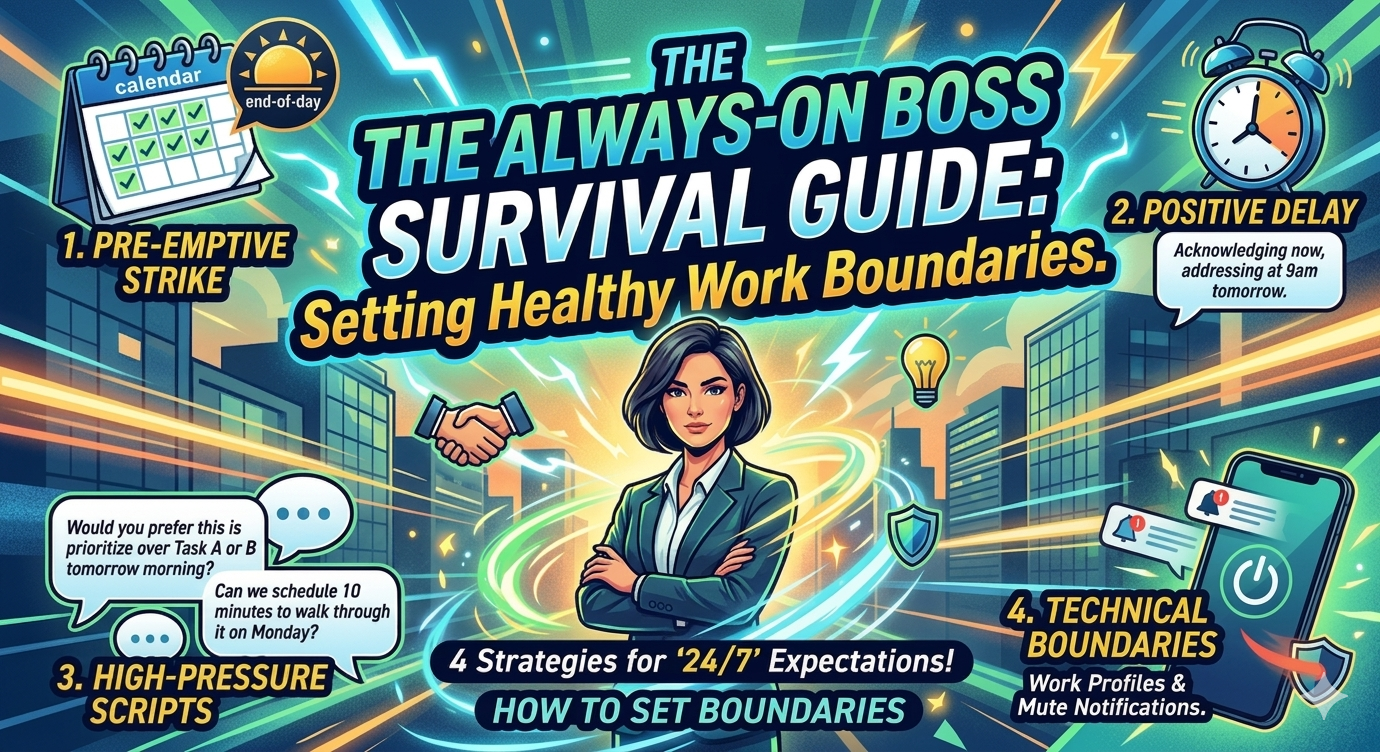
1. The "Pre-emptive Strike" Strategy
The best way to manage expectations is to set them before the midnight email ever arrives.
The "End-of-Day" Wrap-up: Send a brief status update at 5:30 PM. It signals that you’ve completed your tasks for the day and are now signing off.
The Shared Calendar: Block out "Focus Time" or "Family Time" on your public calendar. Visually occupying that space makes people hesitate before intruding.
2. Master the "Positive Delay"
You don’t have to ignore the message, but you shouldn’t solve the problem immediately either. The goal is to acknowledge the message without rewarding the behavior.
The Script: "Hi [Name], I’ve received this! I’m away from my desk right now, but I’ll make this the first thing I tackle when I’m back online at 9:00 AM tomorrow."
3. Scripts for High-Pressure Moments
If the "always-on" culture is becoming a formal expectation, you need to have a direct (but polite) conversation.
When they ask for something late at night:
"I saw your note about the [Project]. Since I’m off the clock for the evening, would you prefer I prioritize this over [Task A] or [Task B] first thing tomorrow morning?"When they call you on a weekend:
"Hey [Name], I’m actually right in the middle of some personal commitments today. If this isn't an absolute emergency, can we schedule ten minutes to walk through it on Monday?"
4. Technical Boundaries (Protect Your Sanity)
Your phone is the biggest traitor in this dynamic. Take control of the hardware:
Work Profiles: Use the "Work Profile" feature on Android or "Focus Modes" on iOS to automatically mute work apps after 6:00 PM.
The "No-Notifications" Rule: Turn off push notifications for email. If it’s a true emergency, they will call. If it's an email, it can wait for a refresh.
Why This Matters
Setting boundaries isn't about being "lazy"—it's about sustainability. A tired, resentful employee is prone to mistakes. By protecting your time, you are actually protecting the quality of your work.
Pro-Tip: If you are working in a global team or a startup environment, clarify "Core Hours" early on. Knowing exactly when you are expected to be "live" removes the guilt of being "dark" during your personal time.
We’ve all had that boss—the one who sends "quick questions" at 10:00 PM on a Saturday or expects an immediate Slack response during your commute. While their drive might be what got them to the top, it shouldn't be what drives you into burnout.
1. The "Pre-emptive Strike" Strategy
The best way to manage expectations is to set them before the midnight email ever arrives.
The "End-of-Day" Wrap-up: Send a brief status update at 5:30 PM. It signals that you’ve completed your tasks for the day and are now signing off.
The Shared Calendar: Block out "Focus Time" or "Family Time" on your public calendar. Visually occupying that space makes people hesitate before intruding.
2. Master the "Positive Delay"
You don’t have to ignore the message, but you shouldn’t solve the problem immediately either. The goal is to acknowledge the message without rewarding the behavior.
The Script: "Hi [Name], I’ve received this! I’m away from my desk right now, but I’ll make this the first thing I tackle when I’m back online at 9:00 AM tomorrow."
3. Scripts for High-Pressure Moments
If the "always-on" culture is becoming a formal expectation, you need to have a direct (but polite) conversation.
When they ask for something late at night:
"I saw your note about the [Project]. Since I’m off the clock for the evening, would you prefer I prioritize this over [Task A] or [Task B] first thing tomorrow morning?"When they call you on a weekend:
"Hey [Name], I’m actually right in the middle of some personal commitments today. If this isn't an absolute emergency, can we schedule ten minutes to walk through it on Monday?"
4. Technical Boundaries (Protect Your Sanity)
Your phone is the biggest traitor in this dynamic. Take control of the hardware:
Work Profiles: Use the "Work Profile" feature on Android or "Focus Modes" on iOS to automatically mute work apps after 6:00 PM.
The "No-Notifications" Rule: Turn off push notifications for email. If it’s a true emergency, they will call. If it's an email, it can wait for a refresh.
Why This Matters
Setting boundaries isn't about being "lazy"—it's about sustainability. A tired, resentful employee is prone to mistakes. By protecting your time, you are actually protecting the quality of your work.
Pro-Tip: If you are working in a global team or a startup environment, clarify "Core Hours" early on. Knowing exactly when you are expected to be "live" removes the guilt of being "dark" during your personal time.